

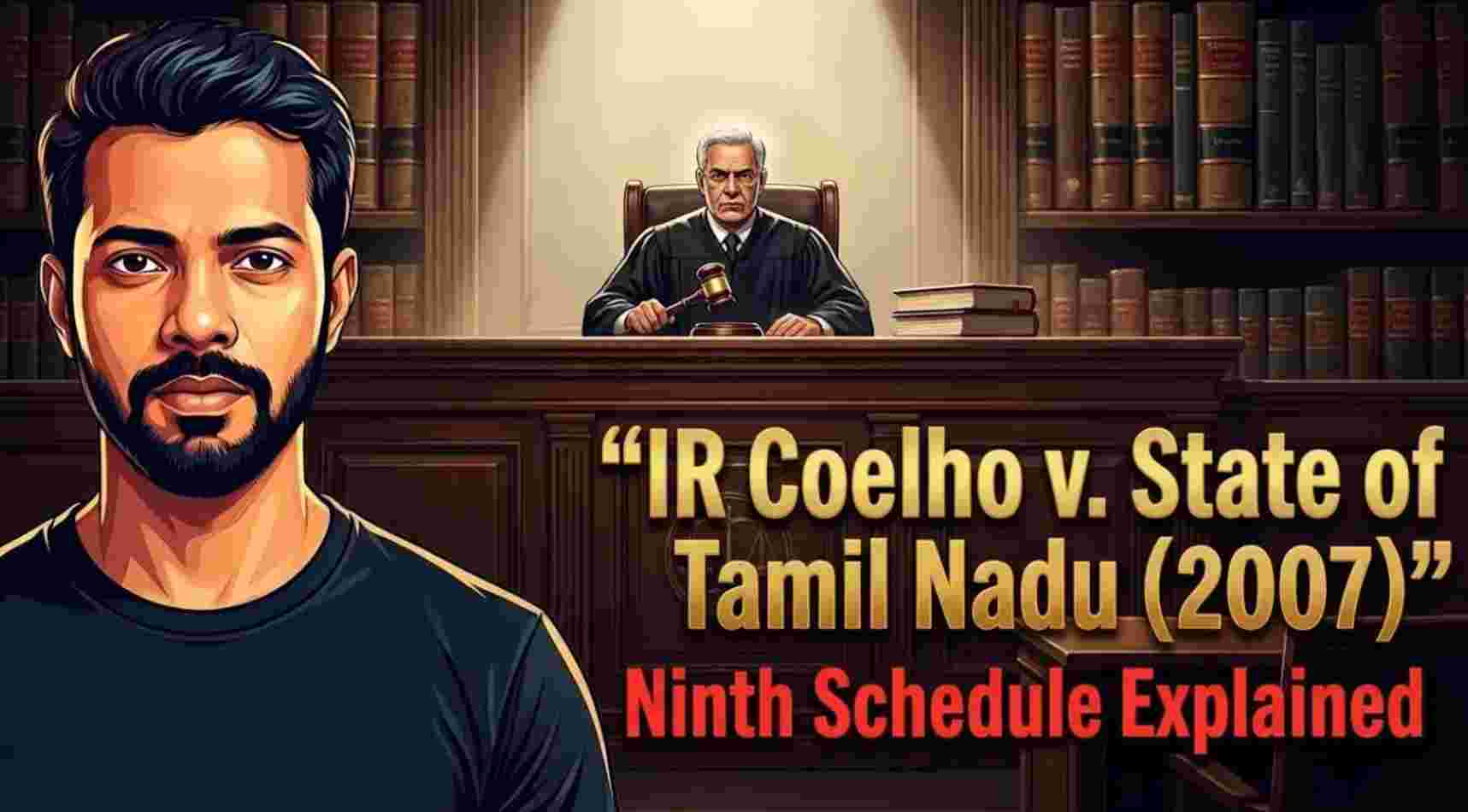
I.R. Coelho v. State of Tamil Nadu (2007)
Ninth Schedule vs. basic structure doctrine – how far can Parliament protect laws from judicial review?

Quick Summary
CASE_TITLE: I.R. Coelho v. State of Tamil Nadu (2007)
In this case, a nine-judge Bench of the Supreme Court looked at a very important question: can Parliament place any law in the Ninth Schedule and make it completely safe from fundamental rights and judicial review?
The Court held that laws put in the Ninth Schedule after the decision in Kesavananda Bharati (24 April 1973) are not absolutely safe. If such laws seriously damage the basic structure of the Constitution, the Court can still review and strike them down. Judicial review itself is part of the basic structure and cannot be removed.
Video Explanation
Use this video along with the written notes. Listen once, then read the case again for stronger recall.
Issues Before the Court
- Issue 1: After 24 April 1973, can Parliament freely place any law in the Ninth Schedule and give it full protection from Part III fundamental rights?
- Issue 2: Can Article 31B and the Ninth Schedule be used to bypass Part III completely, even if that move harms the basic structure of the Constitution?
- Core concern: If a law is otherwise unconstitutional but is later placed in the Ninth Schedule, does it automatically become valid, or can the Court still review it?
Relevant Rules & Constitutional Provisions
Key Articles
- Article 31A: Protects certain land reform and agrarian laws from attack under Part III.
- Article 31B: Gives protection to laws listed in the Ninth Schedule from being struck down for violating fundamental rights.
- Part III: Fundamental rights, including Articles 14, 19, 21 and 32.
- Article 32: Right to move the Supreme Court for enforcement of fundamental rights.
Important Doctrines & Cases
- Basic Structure Doctrine: Parliament can amend the Constitution, but cannot destroy its basic structure (Kesavananda Bharati, 1973).
- Kesavananda Bharati v. State of Kerala: Fixes the 24 April 1973 cut-off and recognises basic structure limits.
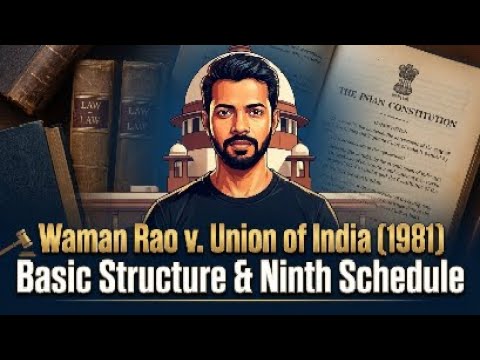
- Waman Rao v. Union of India: Earlier case dealing with Ninth Schedule and the basic structure, later reconsidered in Coelho.
- Judicial Review: Power of courts to test laws and amendments; treated as part of the basic structure.
Facts (Timeline Style)

1969 – Tamil Nadu
The State passes the Gudalur Janmam Estates (Abolition and Conversion into Ryotwari) Act, 1969. It takes tribal forest lands and places them under direct state control as part of land reform.
Supreme Court Scrutiny
The Supreme Court holds that this Act is unconstitutional. It does not fit properly within the protection given to agrarian reforms under Article 31A.
Ninth Schedule Move
To save the law, the Tamil Nadu government places the Act in the Ninth Schedule using Article 31B. Another law, the West Bengal Land Holding Revenue Act, 1979, is also placed in the Ninth Schedule.
Problem
These laws had already been found unconstitutional. By moving them to the Ninth Schedule, they are suddenly insulated from fundamental rights. This looks like a way to escape judicial review.
Challenge
Petitioners argue that Parliament is misusing the Ninth Schedule. According to them, Parliament cannot convert an unconstitutional law into a valid one simply by placing it in that list.
Reference to Larger Bench
A five-judge Bench feels that the Waman Rao (1980) judgment must be reconsidered. The matter is referred to a nine-judge Bench, which delivers the decision in I.R. Coelho.
Arguments: Petitioners vs. Respondents
Petitioners' Arguments
- After 1973, Parliament cannot simply place any law in the Ninth Schedule to protect it from Part III. Doing so would defeat the basic structure doctrine.
- Fundamental rights such as Article 14 (equality), Article 19 (freedoms) and Article 21 (life and liberty) are part of the basic structure and cannot be ignored or removed.
- If Parliament can always shield unconstitutional laws by moving them into the Ninth Schedule, the right under Article 32 becomes meaningless and judicial review is bypassed.
- Courts are guardians of the Constitution. If Parliament decides both the content of laws and their validity, the system of checks and balances collapses.
- Any amendment or move that harms the basic structure, whether inside the Ninth Schedule or elsewhere, must remain open to judicial review.
Respondents' Arguments (Government)
- Article 31B and the Ninth Schedule are valid constitutional tools meant to protect socially important laws and to overrule earlier judicial decisions where needed.
- Relying on Kesavananda Bharati, they argue that amendments are allowed as long as the basic structure is not destroyed. Ninth Schedule entries, in their view, do not automatically break that rule.
- Judicial review may be a basic structure element, but its scope can be regulated by Parliament. The Ninth Schedule only puts a limited restriction, not a total ban.
- Every violation of a fundamental right is not automatically a basic structure violation. Only serious damage to core features should attract the basic structure test.
- Article 31B mainly protects welfare and reform laws. The Court should trust that Parliament will not misuse this power and will act in the spirit of the Constitution.
Supreme Court's Judgment

The Supreme Court clearly held that laws placed in the Ninth Schedule after 24 April 1973 are not immune from judicial review. If such a law violates fundamental rights in a way that harms the basic structure, the Court can strike it down.
- Judicial review is part of the basic structure. Parliament cannot remove or neutralise this power by using the Ninth Schedule.
- The amendment that adds a law to the Ninth Schedule can itself be tested on the touchstone of the basic structure doctrine.
- The Court drew a line: laws put into the Ninth Schedule before Kesavananda Bharati (24 April 1973) are treated as generally settled, while post-1973 entries are open to basic structure review.
Ratio Decidendi (Core Legal Principle)
The central principle from I.R. Coelho is:
Any law placed in the Ninth Schedule after 24 April 1973 can be judicially reviewed. If that law, in its effect, damages the basic structure of the Constitution by heavily violating core fundamental rights, it will be declared unconstitutional.
The Court adopted an impact-based test. The question is not only whether a law violates a right on paper, but whether its actual impact disturbs the Constitution’s basic features such as equality, liberty and judicial review.
Why This Case Matters
- Protects Judicial Review: Confirms that judicial review cannot be switched off by simply using the Ninth Schedule.
- Strengthens Basic Structure: Extends the basic structure doctrine to cover Ninth Schedule amendments as well.
- Limits Parliamentary Power: Parliament’s amending power remains wide but not absolute; it must respect basic structure limits.
- Keeps Balance of Power: Maintains balance between the legislature and the judiciary in constitutional democracy.
- Protects Citizens: Ensures that core rights like equality and life cannot be sacrificed in the name of immunity for welfare laws.
- Clarifies Ninth Schedule: Ninth Schedule is important, but it is not a “safe zone” beyond the Constitution.
Key Takeaways for Students
- Judicial review is part of the basic structure and cannot be removed by an amendment.
- Laws placed in the Ninth Schedule after 24 April 1973 are open to basic structure review.
- Serious violation of core fundamental rights such as Articles 14, 19 and 21 can amount to a basic structure violation.
- The impact of the law on the Constitution’s core features is the key test, not just its wording.
- The Ninth Schedule is not a blanket shield; Parliament’s powers are subject to constitutional supremacy.
Mnemonic + 3-Step Memory Hook
Mnemonic: “CAB Test for Coelho”
Think of CAB like a cab ride that checks Ninth Schedule laws:
- C – Cut-off 1973: after Kesavananda Bharati, Ninth Schedule entries are not automatically safe.
- A – Attack on core rights: if a law hits Articles 14, 19, 21 in a serious way, it is suspicious.
- B – Basic structure test: the Court will test whether the law damages the basic structure.
3-Step Hook
- Step 1 – Story: Recall the story of land laws moved into the Ninth Schedule to escape earlier Supreme Court decisions.
- Step 2 – Question: Ask yourself, “Can Parliament hide any law in the Ninth Schedule forever?” (Answer: No.)
- Step 3 – Answer: Remember “CAB” – Cut-off 1973, Attack on core rights, Basic structure test.
IRAC Outline (Exam-Style)
Issue
Whether Parliament can, after 24 April 1973, place any law in the Ninth Schedule and thereby give it complete immunity from fundamental rights review, even if this harms the basic structure of the Constitution.
Rule
Articles 31A and 31B, Ninth Schedule, Part III (especially Articles 14, 19, 21, 32), and the basic structure doctrine from Kesavananda Bharati. Judicial review and core fundamental rights are part of the basic structure.
Application
The Court examined how placing laws in the Ninth Schedule after 1973 can weaken equality, liberty and judicial review. If the effect of such laws is to damage these core features, then the amendment adding them to the Ninth Schedule is unconstitutional.
Conclusion
Laws inserted into the Ninth Schedule after 24 April 1973 are subject to the basic structure test. If they seriously violate core fundamental rights and thereby damage the basic structure, the Supreme Court can review and strike them down.
Glossary (Student-Friendly Terms)
| Term | Simple Meaning |
|---|---|
| Ninth Schedule | A list of laws that Parliament wanted to protect from being struck down for violating fundamental rights. |
| Basic Structure | The core features of the Constitution that cannot be destroyed, such as democracy, rule of law, judicial review and key rights. |
| Judicial Review | The power of courts to check if laws and amendments are constitutional, and to strike them down if they are not. |
| Agrarian Reform | Reforms related to land, especially redistribution of land and protection of weaker farmers. |
| Article 31B | A provision stating that laws in the Ninth Schedule cannot be declared void for violating fundamental rights. |
| Impact Test | A method where the Court looks at the practical effect of a law on the basic structure, not just its wording. |
FAQs (For Quick Revision)


















































































































































Popular & Recent Post





































Comment
Nothing for now