

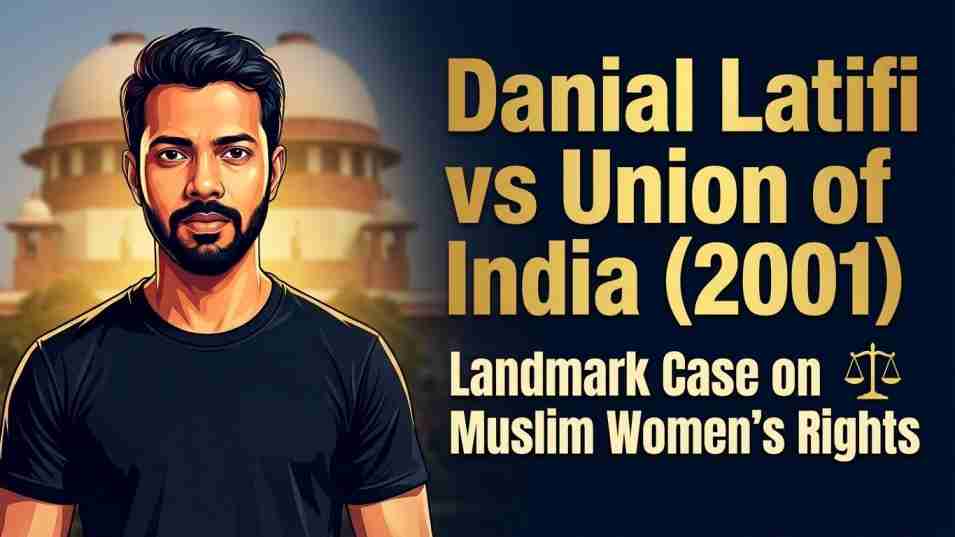
Danial Latifi v. Union of India (2001)
A simple classroom-style explanation of how the Supreme Court of India protected divorced Muslim women’s maintenance rights while reading the Muslim Women Act, 1986 in harmony with Section 125 CrPC and Articles 14, 15 and 21.

Quick Summary
This case explains what happens to a divorced Muslim woman’s right to maintenance after the Muslim Women (Protection of Rights on Divorce) Act, 1986 was passed. Many people feared that this Act had taken away the benefit of Section 125 CrPC, which had earlier helped Muslim women in the Shah Bano case.
In Danial Latifi v. Union of India (2001), the Supreme Court said that the Act is not unconstitutional, but it must be read in a rights-friendly way. The husband has to make a reasonable and fair provision for his divorced wife within the iddat period, but that provision should take care of her future life beyond iddat. If she is still not able to maintain herself, she can also claim from her relatives or the Wakf Board.
In simple words: the Court used Articles 14, 15 and 21 to protect Muslim women from destitution, without striking down the 1986 Act, and kept the spirit of Shah Bano alive.
Issues Before the Court
-
Can a divorced Muslim woman claim maintenance under Section 125 CrPC?
Is Section 125 CrPC, which is a secular and social justice provision, still available to her even after the Muslim Women (Protection of Rights on Divorce) Act, 1986? -
Is the 1986 Act unconstitutional?
Does the Act violate Article 14 (equality), Article 15 (no discrimination on religion/sex) and Article 21 (right to life with dignity) by limiting a divorced Muslim woman’s maintenance only to the iddat period? -
How should the 1986 Act be interpreted?
Can the Act be read in a way that protects Muslim women’s rights and also respects the personal law, or should it be struck down?
Rules / Legal Provisions
-
Section 125, Code of Criminal Procedure, 1973
A secular provision for basic maintenance of wives, children and parents, to prevent destitution and vagrancy. It applies to persons of all religions. -
Muslim Women (Protection of Rights on Divorce) Act, 1986
- Section 3: Husband must make reasonable and fair provision and maintenance for his divorced wife, to be made and paid within the iddat period.
- Section 4: If the woman cannot maintain herself after divorce, she may claim maintenance from her relatives or, failing that, from the Wakf Board.
-
Constitution of India
- Article 14: Equality before law and equal protection of laws.
- Article 15: No discrimination on grounds of religion, race, caste, sex or place of birth.
- Article 21: Right to life and personal liberty, including a life with dignity.
These provisions together form the legal background for deciding whether Muslim women can be given effective maintenance after divorce without violating the Constitution.
Facts – Timeline Style
Shah Bano’s Divorce (1978)
Shah Bano, a Muslim woman from Indore and mother of five children, was divorced by her husband in 1978. She had no independent income and needed financial support.
Maintenance Claim under Section 125 CrPC
She filed a case under Section 125 CrPC asking for maintenance from her former husband. The case travelled through the courts and reached the Supreme Court.
Shah Bano Judgment
The Supreme Court held that even a divorced Muslim woman is entitled to maintenance under Section 125 CrPC if she cannot maintain herself. This was seen as a strong judgment in favour of women’s rights.
1986 Act Passed
After public and political debate, Parliament passed the Muslim Women (Protection of Rights on Divorce) Act, 1986. Many read it as restricting maintenance for divorced Muslim women only to the iddat period (around three months).
Doubt and Confusion
This created fear that Muslim women would again be left without long-term support and that the Shah Bano protection had been cancelled in practice.
Petition by Advocate Danial Latifi
Advocate Danial Latifi, who had represented Shah Bano earlier, filed a petition in the Supreme Court challenging the constitutional validity of the 1986 Act and asking the Court to protect Muslim women’s rights under the Constitution.
Arguments – Petitioner vs Respondent
Petitioner (Danial Latifi)
- Section 125 CrPC is secular: It protects wives of all religions and is meant to prevent destitution and begging. Removing Muslim women from this protection is unfair.
- Link with Article 21: Maintenance is closely tied to the right to life with dignity. A divorced woman left without support cannot live a dignified life.
- Discrimination under Articles 14 and 15: If non-Muslim divorced women can claim long-term maintenance but Muslim divorced women get only a short iddat-period support, then the law discriminates on the ground of religion and sex.
- Effect of the 1986 Act: In practice, the Act was seen as undoing the Shah Bano judgment and weakening “basic human values” and justice for women.
- Constitutional and Islamic fairness: The Act, as understood by many, was both unconstitutional and inconsistent with true Islamic principles of fairness to women, and it harmed India’s secular character.
Respondent (Union of India)
- Special statute for Muslim women: The government argued that the Act is a specific law made to protect divorced Muslim women, based on personal law. This, by itself, does not violate Article 14.
- Meaning of “reasonable and fair provision”: The Act asks the husband to pay a reasonable and fair provision and maintenance within the iddat period. The government claimed this is a complete package and need not be life-long monthly maintenance.
- Personal law as a valid basis: Different communities may have different personal laws, and such differences are not automatically unconstitutional.
- Power of Parliament: Parliament has the power to create a new law or modify Section 125 CrPC. Passing the Act was within its legislative competence.
- Alternative support system: Even if the husband’s duty is limited, the Act provides that relatives and the Wakf Board can also be made responsible, so Muslim women are not left without any support.
Court’s Analysis and Final Judgment
Court’s Key Reasoning
- Section 125 CrPC as social justice law: The Court described Section 125 as a social justice measure. It is not tied to any one religion and exists to stop women (and others) from falling into destitution. Muslim women are not automatically excluded from its protection.
- Interpreting “iddat” and future provision: The Court carefully read the phrase “reasonable and fair provision and maintenance” in the 1986 Act. It held that the husband’s duty is not only to pay for the iddat period; instead, he must make a provision for the wife’s future, though this provision has to be arranged within the iddat period.
- Saving the Act, not striking it down: Instead of declaring the Act void, the Court chose a harmonious interpretation. It explained the Act in a way that fits with Articles 14, 15 and 21 and keeps the protection given in Shah Bano effectively alive.
- Backup support from relatives and Wakf Board: The Court noted that Sections 3 and 4 together create a safety net. If the divorced woman is still not able to maintain herself, her relatives and the Wakf Board can also be directed to support her.
Final Holding
- The Muslim Women (Protection of Rights on Divorce) Act, 1986 is constitutional. It does not violate Articles 14, 15 and 21 when read correctly.
- A Muslim husband must make a reasonable and fair provision for his divorced wife’s future within the iddat period. This financial arrangement can cover her beyond the iddat period.
- If the woman is still not able to maintain herself and remains unmarried, she can seek maintenance from her relatives and, if necessary, from the Wakf Board.
- The spirit of Shah Bano is preserved: a divorced Muslim woman is not to be left in poverty; the law must be read as protecting her dignity.
Ratio Decidendi
The core legal principle (ratio decidendi) in Danial Latifi v. Union of India is:
The husband’s obligation under the Muslim Women (Protection of Rights on Divorce) Act, 1986 is to make a reasonable and fair provision for the divorced wife’s future within the iddat period, and this obligation is consistent with Articles 14, 15 and 21 when the Act is interpreted in a rights-protective manner.
- The 1986 Act does not confine maintenance to the iddat period alone; it requires a lump-sum or suitable provision that can sustain the woman beyond iddat.
- Constitutional guarantees of equality and dignity guide the interpretation of personal law statutes so that women are not left destitute.
- Courts should, where possible, harmonise personal law with fundamental rights instead of striking down the statute.
Why This Case Matters
- Protection for divorced Muslim women: The case shows that courts will not let divorced Muslim women be pushed into destitution in the name of personal law.
- Harmony between personal law and Constitution: Instead of choosing between “personal law” and “fundamental rights”, the Court tried to harmonise them.
- Power of interpretation: The decision is a classic example of how the Supreme Court uses interpretation as a tool for social justice, instead of always striking down laws.
- Continuity with Shah Bano: Students can see how Danial Latifi keeps the idea of Shah Bano alive, but in a different statutory framework.
- Important for exams and practice: The case is frequently asked in family law, constitutional law and women and law papers, and is useful for understanding Muslim women’s rights in practice.
Key Takeaways for Students
- Takeaway 1: Section 125 CrPC is a secular social justice tool. It cannot be casually taken away from any group of women.
- Takeaway 2: The 1986 Act, when read properly, does not confine Muslim women’s maintenance only to three months of iddat.
- Takeaway 3: The husband’s duty is to create a reasonable and fair provision for future life, not just small short-term expenses.
- Takeaway 4: Articles 14, 15 and 21 act as guiding stars for reading personal law statutes in a gender-just way.
- Takeaway 5: Courts can “save” a law by progressive interpretation instead of always striking it down as unconstitutional.
- Takeaway 6: For exams, always connect Danial Latifi with Shah Bano and the Muslim Women Act, 1986.
Mnemonic + 3-Step Memory Hook
Mnemonic: “IDDA – I Dignify Divorced Alimony”
Think of IDDA as a reminder that even within the iddat period, the law must dignify a divorced woman’s alimony and future life.
- I – Interpret the Act with the Constitution: Court reads the 1986 Act in line with Articles 14, 15, 21.
- D – Duty beyond iddat: Husband’s duty is to make a future provision, not only iddat-period maintenance.
- DA – Destitution Avoided: Relatives and Wakf Board can also be made responsible so that no Muslim woman is left destitute.
Repeat the line: “IDDA keeps dignity after divorce”. This will help you recall that the case is about protecting dignity and maintenance of divorced Muslim women beyond the iddat period.
IRAC Outline – Danial Latifi v. Union of India
I – Issue
Whether the Muslim Women (Protection of Rights on Divorce) Act, 1986 violates Articles 14, 15 and 21 by limiting maintenance of divorced Muslim women to the iddat period, and how it should be interpreted along with Section 125 CrPC.
R – Rule
- Section 125 CrPC – secular maintenance provision.
- Muslim Women Act, 1986 – Sections 3 and 4 on provision and maintenance.
- Articles 14, 15, 21 – equality and dignity.
A – Application
The Court read “reasonable and fair provision and maintenance” as requiring the husband to make a future-oriented financial arrangement within the iddat period. This interpretation respects personal law language but also ensures that divorced Muslim women do not lose the substantive protection given to other women under Section 125 CrPC and the Constitution.
C – Conclusion
The Act is constitutional. It is to be interpreted in a way that preserves long-term maintenance for divorced Muslim women, allows backup support from relatives and the Wakf Board, and keeps the essence of the Shah Bano principle alive under Articles 14, 15 and 21.
Glossary – Important Terms
- Iddat
- Waiting period after divorce during which a Muslim woman cannot remarry. In this case, it is a key time frame within which the husband must arrange a fair provision for her future.
- Maintenance
- Financial support needed for basic living expenses like food, clothing, shelter and medicine. It is linked to the right to live with dignity.
- Section 125 CrPC
- A secular provision in the Criminal Procedure Code that allows wives, children and parents to claim maintenance, regardless of religion, to prevent destitution.
- Wakf Board
- A statutory body that manages Wakf properties for the benefit of the Muslim community. Under the 1986 Act, it can be made responsible for supporting a divorced Muslim woman if needed.
- Harmonious Interpretation
- A method where the court tries to read different laws together in a way that avoids conflict and protects constitutional values, rather than striking down the law.
Student-Friendly FAQs









































































































































Popular & Recent Post













































Comment
Nothing for now