

Maneka Gandhi v. Union of India (1978) – Article 21, Fair Procedure and the Passport Case
A student-friendly explanation of how the Supreme Court turned Article 21 into a powerful shield for fair, just and reasonable procedure, and linked it with Articles 14 and 19.

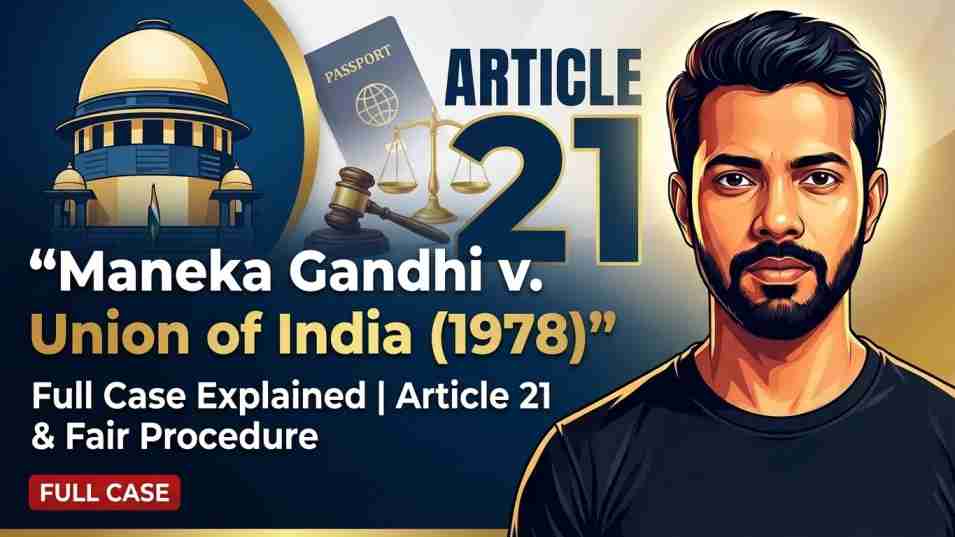
Maneka Gandhi v. Union of India (1978)
Watch & ReviseYou can embed your own YouTube video for this case here. Just replace the video URL in the iframe below.
Quick Summary
CASE_TITLE: Maneka Gandhi v. Union of India (1978)
Maneka Gandhi’s passport was impounded by the government without giving her proper reasons or a chance to be heard. She went straight to the Supreme Court under Article 32 and argued that this action violated her rights under Articles 14, 19 and 21.
The Court used this case to completely change the way it understood Article 21. It said that any law which takes away personal liberty must be fair, just and reasonable. It cannot be arbitrary or oppressive. The Court also held that Articles 14, 19 and 21 are closely linked and must be read together.
PRIMARY_KEYWORDS: Maneka Gandhi v. Union of India case summary, Article 21 fair just and reasonable, Articles 14 19 21 linkage, right to travel abroad.
SECONDARY_KEYWORDS: Passport Act Section 10(3)(c), natural justice audi alteram partem, procedure established by law, Supreme Court of India due process.
PUBLISH_DATE: 1 December 2025 |
AUTHOR_NAME: Gulzar Hashmi |
LOCATION: India |
Slug: maneka-gandhi-v-union-of-india-1978
Issues Before the Court
- Can Articles 14, 19 and 21 be read together as one combined protection for personal liberty?
- Is the procedure under the Passport Act for impounding a passport fair, just and reasonable?
- Does the right to travel abroad form part of “personal liberty” under Article 21?
- Does “procedure established by law” include the basic principles of natural justice?
- Can a law that is unfair, arbitrary or unreasonable still be treated as a valid law under Article 21?
- Does impounding a passport without giving a hearing violate the rule of audi alteram partem?
- Is Section 10(3)(c) of the Passport Act, 1967 unconstitutional for being too wide or vague?
Rules and Legal Provisions
Constitutional Articles
- Article 14 – Equality before law; no arbitrary state action.
- Article 19 – Fundamental freedoms (including movement and expression).
- Article 21 – Protection of life and personal liberty; “procedure established by law”.
- Article 22 – Safeguards in case of arrest and detention.
- Article 32 – Right to move the Supreme Court for enforcement of fundamental rights.
Statute and Case Law
- Passport Act, 1967 – Especially Section 10(3)(c) (impounding in public interest).
- Satwant Singh Sawhney v. A.P.O., New Delhi – Right to travel abroad as part of personal liberty.
- A.K. Gopalan v. State of Madras – Earlier narrow view of Article 21 and “procedure established by law”.
The Court had to decide whether the Passport Act’s procedure met constitutional standards of fairness, and whether earlier views in A.K. Gopalan needed to be updated.
Facts – Timeline Style
ChronologyPassport Issued: Maneka Gandhi was issued a passport under the Passport Act, 1967.
2 July 1977: She received a notice from the Regional Passport Officer directing her to surrender her passport within 7 days.
Reason Given: When she asked for the reason, the government only said that it was “in public interest” and refused to share any further details.
No Hearing: She was not given any opportunity of personal hearing before the decision was taken.

Feeling that this one-line “public interest” reason was unfair and arbitrary, Maneka Gandhi filed a writ petition under Article 32 directly before the Supreme Court. She claimed violation of her rights under Article 14 (equality), Article 19 (freedoms) and Article 21 (personal liberty).
Arguments – Petitioner vs Respondent
Adversarial ViewPetitioner: Maneka Gandhi
- Right to travel abroad = personal liberty: The right to go abroad is part of personal liberty under Article 21. Taking the passport away without fair procedure violates this right.
- Procedure must be fair: Article 21 does not protect any and every procedure. The procedure must be fair, just and reasonable, not a mere formality.
- Law is arbitrary: The Passport Act does not set out clear, detailed safeguards for impounding a passport, so the power can be used in an arbitrary way.
- Articles 14, 19, 21 are linked: A law under Article 21 must also satisfy equality under Article 14 and freedoms under Article 19. These rights support each other.
- Natural justice ignored: Impounding the passport without giving her a prior hearing violates the principle of audi alteram partem – the right to be heard.
- Comparison with Article 22: Even in arrest and detention under Article 22, basic safeguards are given. Here, her movement was restricted without any such safeguards.
Respondent: Union of India
- No Article 19 protection: The right to travel abroad, according to the State, is not covered by Article 19; so there is no question of violating that Article.
- Public interest and secrecy: Passport was impounded in public interest. In such matters, the State need not disclose all reasons, especially where national security might be involved.
- Statutory backing: Section 10(3)(c) of the Passport Act clearly authorises the State to impound passports in public interest. The order was passed under a valid law.
- Natural justice is flexible: Granting a personal hearing in every administrative decision is not practical. Natural justice rules vary with context and can be limited.
- Law vs misuse: Even if an individual order is wrong, that would not make the whole section unconstitutional. Courts can set aside bad orders without striking down the law.
- Meaning of Article 21: “Procedure established by law” means any procedure laid down in a validly enacted law. It does not require the Court to check whether that procedure is reasonable.
Judgment – Majority, Concurring and Dissent
Supreme Court VerdictMajority Opinion – Justice P.N. Bhagwati
- Broad meaning of personal liberty: Personal liberty under Article 21 is a wide concept. It includes many rights that make life meaningful, including the right to travel abroad.
- Golden triangle of Articles 14, 19, 21: These three Articles are not separate islands. A law that affects personal liberty must pass all three tests together.
- Fair, just and reasonable procedure: “Procedure established by law” means a procedure that is fair, just and reasonable. It cannot be arbitrary, fanciful or oppressive.
- Natural justice as part of Article 21: Where a decision affects rights, principles of natural justice are normally implied, unless clearly excluded for strong reasons.
- Section 10(3)(c) upheld: The section itself was held valid because it contained some safeguards such as written reasons and right of appeal. However, orders passed under it must themselves be fair and non-arbitrary.

Justice V.R. Krishna Iyer (Concurring)
He stressed that Article 21 cannot be satisfied by a foolish or bizarre law. The history of liberty is the history of procedural safeguards. Procedure must make sense and protect real freedom, not just follow empty forms.
Justice Y.V. Chandrachud (Concurring)
He pointed out that freedom of speech and expression is not confined by territory. Restricting travel abroad can also affect a person’s ability to express and communicate ideas beyond India’s borders.
CJ Hameedullah Beg (Concurring)
He accepted that in rare emergencies, prior hearing may not be possible, but in normal situations a fair hearing should be given. Natural justice is generally implied even when the statute is silent.
Dissent – Justice P.S. Kailasam
Justice Kailasam did not agree with the majority on all points. He held that the right to travel abroad is not protected under Article 19 and that following the procedure in the Passport Act is enough to satisfy Article 21.
In his view, natural justice is not automatically implied in every case. If the statute followed its own procedure, the Court should not add extra requirements unless the law clearly violates a fundamental right.
Ratio Decidendi
- Substantive due process: Article 21 protects not only against absence of law but also against unfair laws. A law which takes away personal liberty must itself be just, fair and reasonable.
- Integrated reading of rights: Articles 14, 19 and 21 must be read together. Any law affecting personal liberty must satisfy equality (Article 14) and reasonableness of restrictions (Article 19), along with fair procedure (Article 21).
- Natural justice built into procedure: Unless expressly excluded and for strong reasons, principles of natural justice like the right to be heard are implied in statutory powers that affect rights.
- Right to travel abroad: The right to travel abroad is part of personal liberty, following Satwant Singh, but it can be restricted through a fair law serving a legitimate public interest.
- Section 10(3)(c) constitutionally valid: The provision is valid, but its exercise must be non-arbitrary. Orders passed under it can be challenged and struck down if they violate fundamental rights.
Why This Case Matters
Maneka Gandhi v. Union of India is often called a constitutional revolution because it changed the mindset of the Court. Earlier, the Court focused only on whether there was a law. After this case, the focus shifted to the quality of that law and procedure.
The judgment opened the door for expanding fundamental rights relating to dignity, privacy and fair treatment. Later cases like K.S. Puttaswamy (Right to Privacy) and many human rights decisions build on the same logic that liberty needs a fair and non-arbitrary legal framework.
For students, this case is a bridge between the old, formal view of the Constitution and the modern, rights-based view that treats the individual as the centre of constitutional protection.
Key Takeaways for Students
- Article 21 requires a fair, just and reasonable procedure – not any procedure.
- Articles 14, 19 and 21 form a “golden triangle” of rights that support each other.
- The right to travel abroad is part of personal liberty, but subject to reasonable and fair restrictions.
- Natural justice is usually implied even if a statute is silent, especially when rights are at stake.
- Maneka Gandhi limited the earlier narrow approach in A.K. Gopalan and moved closer to “due process” thinking.
- Laws that are arbitrary, oppressive or excessively vague can be challenged even if Parliament passed them.
- The case is a starting point for understanding modern Article 21 jurisprudence, including privacy and dignity.
- Always cite this case when arguing that procedure must be fair and non-arbitrary in constitutional law answers.
Mnemonic + 3-Step Memory Hook
Mnemonic: MANEKA
Remember the core ideas of the case with the word MANEKA:
- M – Merged rights: Articles 14, 19, 21 read together.
- A – Against arbitrariness: law cannot be arbitrary.
- N – Natural justice implied in procedure.
- E – Expanded liberty: personal liberty has wide meaning.
- K – Kills old view of narrow “procedure established by law”.
- A – Abroad travel covered under Article 21.
3-Step Hook Story
- Step 1 – Airport Scene: Imagine Maneka standing at the airport gate. An officer suddenly takes away her passport saying only “public interest”. This reminds you of arbitrariness.
- Step 2 – Triangle Shield: Behind her, a glowing triangle with the numbers 14, 19 and 21 appears like a shield. This reminds you that all three rights work together.
- Step 3 – Weighing Scale with “Fair Procedure”: The Supreme Court’s weighing scale appears, and the words “Fair, Just, Reasonable” balance on it. This fixes the new meaning of Article 21 in your mind.
IRAC Outline (Exam-Style)
I – Issue:
Whether the impounding of Maneka Gandhi’s passport under Section 10(3)(c) of the Passport Act, without giving her reasons and a prior hearing, violated her fundamental rights under Articles 14, 19 and 21 of the Constitution.
R – Rule:
Article 21 protects personal liberty and allows deprivation only by “procedure established by law”. Articles 14 and 19 guarantee equality and freedoms subject to reasonable restrictions. The Passport Act allows impounding in public interest. Natural justice requires that a person affected by a decision should normally be given a fair opportunity of being heard.
A – Application:
The Court held that Articles 14, 19 and 21 must be read together. Therefore, the procedure under the Passport Act must be fair, just and reasonable and cannot be arbitrary. The one-line “public interest” reason and denial of hearing made the order suspect. To save the statute, the Court read into Section 10(3)(c) a duty to provide written reasons and a fair opportunity of hearing, except in rare urgent situations.
C – Conclusion:
The Court upheld the constitutional validity of Section 10(3)(c), but held that the order impounding Maneka Gandhi’s passport violated the requirements of fair procedure and natural justice. It directed that she must be given proper reasons and a meaningful chance to be heard, firmly establishing that Article 21 requires fair, just and reasonable procedure.
Glossary – Simple Meanings
- Procedure established by law
- The process or method laid down in a law passed by Parliament or the State legislature, which must now be fair, just and reasonable.
- Natural justice
- Basic fairness in decision-making, including the right to be heard and the rule that no person should be a judge in their own cause.
- Personal liberty
- The wide range of freedoms which allow an individual to live with dignity, including movement, travel and making personal choices.
- Arbitrariness
- Action taken on the basis of whim or personal choice, without rational reasons or fair standards, which is not allowed under Article 14.
- Public interest
- The welfare or security of the community as a whole. It can justify restrictions on rights but cannot be used as a vague excuse.
- Golden triangle
- A term used for the joint reading of Articles 14, 19 and 21 as three strong supports that protect individual liberty together.
FAQs – Student Doubts Answered












































































































































Popular & Recent Post



























































Comment
Nothing for now