

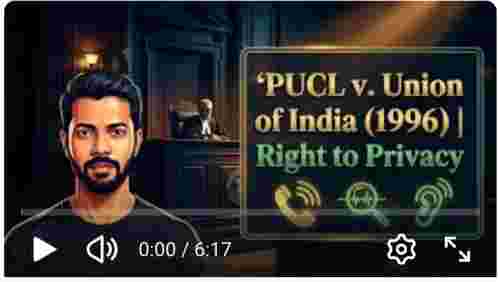
PUCL v. Union of India (1996) – Phone Tapping & Right to Privacy
pucl-v-union-of-india-1996-phone-tapping-right-to-privacy

Table of Contents
Horizontal Quick Navigation
Quick Summary
Read this first
This case is about how far the Indian Government can go in tapping telephones and how the Constitution protects a person’s privacy. The Supreme Court had to balance national security with individual freedom.
- In the 1990s, a report showed that phones of politicians were being tapped without proper safeguards.
- People’s Union for Civil Liberties (PUCL) filed a PIL challenging the way Section 5(2) of the Indian Telegraph Act was used.
- The Court accepted that privacy is part of Article 21 and that phone tapping is a serious invasion of that privacy.
- The Court did not strike down Section 5(2) but created strict guidelines to prevent misuse.
- These guidelines became a key reference point for surveillance and privacy law in India.
Issues Before the Court
Key questions
- Does large-scale and unchecked phone tapping under Section 5(2) violate the right to privacy under Article 21?
- Are telephone conversations protected as part of freedom of speech and expression under Article 19(1)(a)?
- Is Section 5(2) of the Indian Telegraph Act itself unconstitutional, or can it be saved by adding procedural safeguards?
- What minimum safeguards are necessary to stop arbitrary and politically motivated phone tapping by the Government?
Rules & Legal Provisions
Statutes & constitutional provisions
-
Section 5(2), Indian Telegraph Act, 1885
Allows the Government to intercept messages during a public emergency or in the interest of public safety on grounds such as sovereignty, security of the State, friendly relations with foreign States, public order and prevention of offences. -
Article 21
Protects life and personal liberty. The Court read the right to privacy as part of this guarantee. -
Article 19(1)(a) & 19(2)
Protects freedom of speech and expression and permits reasonable restrictions, which also apply to telephone conversations. -
Earlier case law
Kharak Singh, Gobind and R. Rajagopal recognised privacy as a constitutional interest even before this case.
Facts – Timeline Style
What actually happened?
Early 1990s – Phone tapping controversy
A report from the CBI revealed that phones of several political leaders were tapped. The tapping was done through MTNL acting on Government requests. Many basic procedures were not followed.
Rise of public concern
People began to feel that their private conversations were not safe. It was not clear who could order tapping and how such powers were being checked.
PUCL files a PIL
People’s Union for Civil Liberties (PUCL), a voluntary organisation working for civil rights, filed a Public Interest Litigation in the Supreme Court. They challenged the use and misuse of Section 5(2) of the Indian Telegraph Act.
The case reaches the Supreme Court
The Court had to decide whether such tapping violated the right to privacy and whether the law needed to be struck down or “read down” by adding safeguards.
Final judgment in 1996
In 1996, the Supreme Court delivered its judgment. It kept Section 5(2) but laid down strong interim guidelines to control phone tapping.

Arguments – PUCL vs Government
Appellant vs Respondent
| PUCL (Petitioner) | Union of India (Respondent) |
|---|---|
|
|
|
|
|
|
|
|
Judgment – What the Supreme Court Decided
Final decision & guidelines
Section 5(2) not struck down
The Court refused to declare Section 5(2) unconstitutional. It held that the grounds listed in the provision are valid, but the real problem is lack of detailed procedure.
Privacy and speech recognised
- Telephone conversations are part of the right to privacy under Article 21.
- They are also a part of freedom of speech under Article 19(1)(a) and can be restricted only under Article 19(2).
- Phone tapping is therefore a serious interference and must be used sparingly.
Key interim guidelines
- Authority: Normally, only the Home Secretary (Central or State) can order interception. In emergencies, a properly authorised senior officer may act.
- Necessity test: Interception can be ordered only when information cannot be collected in any other reasonable way.
- Time limit: An order is valid for a maximum of two months at a time and can be renewed up to a total of six months.
- Record keeping: Detailed records of each interception order and its review must be kept.
- Limited use & destruction: Intercepted material must be used only for the stated purpose and destroyed once it is no longer needed.
- Review committees: Review Committees at Central and State level must check whether orders follow the law and recommend cancellation if they do not.

Ratio Decidendi
Core legal principle
The central principle of this case is that the State may intercept telephone conversations only in rare and clearly defined situations. Because phone tapping is a grave invasion of privacy and speech, strict procedures and oversight are constitutionally required.
- Right to privacy forms part of “life and personal liberty” under Article 21.
- Telephone conversations come within both privacy and freedom of speech.
- Section 5(2) is valid only if applied narrowly and with robust safeguards, as laid down by the Court.
- The Court can frame guidelines when a statute is silent on procedure and there is risk of abuse.
Why This Case Matters
Classroom significance
- Pre-Puttaswamy privacy case: It strengthened privacy even before the 2017 nine-judge bench in Puttaswamy.
- Checks on surveillance: It placed clear limits and procedures on State surveillance powers.
- Tech relevance: The logic of this case still guides debates on interception, data monitoring and digital privacy.
- Exam-friendly: It is frequently asked under topics like privacy, Article 21, and telephone tapping.
- Balance model: It shows how courts balance national security with individual rights instead of choosing only one side.
Key Takeaways for Students
For quick revision
- Privacy is now clearly treated as a fundamental right under Article 21.
- Telephone conversations are covered by both privacy and free speech rights.
- Section 5(2) survives but operates only with strong safeguards.
- Only high-level authorities (Home Secretaries) can normally order interception.
- Interception must be necessary, time-bound and properly recorded.
- Review Committees act as a built-in control mechanism.
- Case is an important bridge between earlier privacy cases and modern digital privacy law.
Mnemonic + 3-Step Hook
Memory helper
Mnemonic: “TAP SAFE”
Think of the phrase TAP SAFE to remember the case:
- T – Telephone conversations
- A – Article 21 privacy + Article 19(1)(a) speech
- P – Procedural safeguards
- S – Section 5(2) survives
- A – Authorised Home Secretary
- F – Fixed time limits
- E – Emergency review & data destruction
3-Step Exam Hook
- Step 1 – Start with the story: CBI report, political phone tapping, PUCL’s PIL and public fear about privacy.
- Step 2 – State the principle: Privacy + phone calls are protected, Section 5(2) is valid but only with strict safeguards.
- Step 3 – Finish with the guidelines: Home Secretary orders, necessity test, time limits, records, review committees and destruction of data.
IRAC Outline
Exam-structured answer
Issue
Whether the wide and uncontrolled use of phone tapping under Section 5(2) of the Indian Telegraph Act violates the fundamental right to privacy and free speech, and if the provision needs to be struck down or read down with safeguards.
Rule
Article 21 protects life and personal liberty, including privacy. Article 19(1)(a) protects speech, subject to reasonable restrictions under Article 19(2). Section 5(2) permits interception only during public emergency or in the interest of public safety on specific grounds such as security of the State and public order.
Application
The CBI report showed that phones were tapped without clear limits and checks. The Court held that telephone conversations are part of privacy and free speech. Section 5(2) cannot be used as a blanket licence to listen to citizens. Since the law did not prescribe detailed procedure, the Court read in guidelines on who may order interception, how long it can last, what records must be kept and how review committees must function.
Conclusion
The Court upheld Section 5(2) but held that phone tapping is a serious invasion of privacy and must satisfy strict constitutional standards. The case therefore preserves State security powers while building a strong procedural shield around the right to privacy.
Glossary – Important Terms
Quick meanings
- Phone tapping
- Secret listening to telephone conversations, usually by the State, often without the knowledge of the caller.
- Right to privacy
- The right of a person to be left alone and to control information about their personal life and communications.
- Public emergency
- A situation of serious danger to the nation or public safety that may justify temporary extra powers for the State.
- Public safety
- Protection of the general public from serious threats such as terrorism, violent crime or serious disorder.
- Procedural safeguards
- Step-by-step rules that limit how a power may be used, such as who can authorise it, for how long, and under what review.
- Review Committee
- A group of officials that checks whether interception orders follow the law and recommends cancellation where they do not.
FAQs – Student Doubts
Short Q&A


















































































































































Popular & Recent Post


























Comment
Nothing for now